
Condition, Provenance, Patience - A Conversation with Pom Harrington
The owner of Peter Harrington on rare books, side doors, and the quiet compounding of reputation

“A book is a version of the world. If you do not like it, ignore it; or offer your own version in return.” - Salman Rushdie
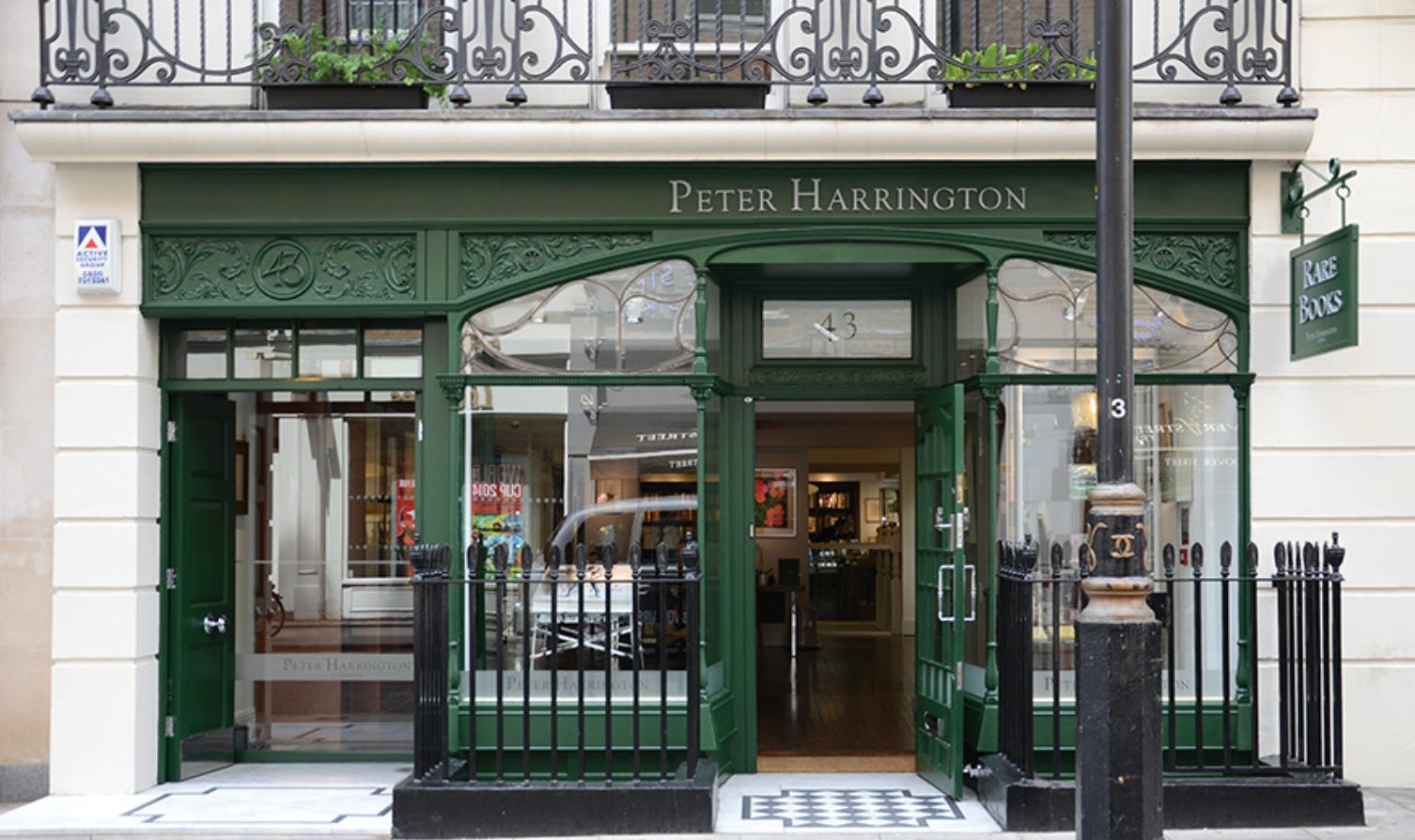
Continuing the interview series, this week’s conversation moves out of finance and into a corner of the luxury world I have always loved: rare books. Pom Harrington is the owner of Peter Harrington, the London rare book dealer his father started from a single shelf in a Chelsea antiques market in the late 1960s. The shop on Fulham Road is one of the stops I make almost every time I am in London for client meetings, and Captain’s Courageous, a book my father read to me growing up, sits on my shelf at home in a copy that came from them.
Pom joined the family business in 1994 at nineteen, straight out of school, after deciding university was not for him. He had spent teenage summers packing books at his father’s stand, and went full-time the year he stopped pretending he was going to do anything else. In 1997 the Harrington brothers split the business and Pom and his father started Peter Harrington properly, with four people including Pablo, who still runs the Dover Street shop today. They have grown every year since, adding books, people, knowledge, shops, and a bindery. The most recent chapter is American: last year Peter Harrington opened a standalone gallery on New York’s Upper East Side, building on the firm’s 2022 co-acquisition of the Americana specialist William Reese Company, which operates as a separate business and itself moved to new New York premises last year.
“The book is getting rarefied again.”
Pom’s framing of the modern rare book market is the opposite of the one I expected to hear. The conventional wisdom, that physical books are a fading category quietly losing shelf space to Kindles and iPads, badly misreads what is actually happening. The paperback, in his telling, was invented in the late nineteenth century as a cheap reading implement, and the world used to print hundreds of millions of them and throw them away. The Kindle replaces the paperback. A hardback, a fine quality printed book, is a different object entirely, and the electronic age is pushing publishing back toward higher quality and lower print runs. Fewer copies, better made. Which is precisely the condition under which a book becomes collectible in the first place.
More interesting is the demographic shift on the demand side. The buyers walking into Peter Harrington on a Saturday, or filling FIRSTS, London’s Rare Book Fair, held at the Saatchi Gallery, are younger than they were a decade ago. Under thirty-five, often under thirty. The generation that grew up entirely digital finds physical books cooler and more interesting than the generation that grew up surrounded by them ever did. I saw it myself the last time I was in the Fulham Road shop, where the average age in the room was a good fifteen years below what I had expected. For a category that the consensus view writes off as structurally declining, that is a quietly remarkable signal.
“It is a passion investment, not an investment.”
Pom is firm, almost insistent, that rare books are not an investment product, and he will not sell them as one. The reason is liquidity. The market is steady but thin, and anyone moneyed enough to be buying serious books is, in his words, not stupid, and works that out quickly. What you actually buy is a passion asset. You find the best quality copy you can at the best price, and you hold it because you love it. People sell when hobbies change, when someone dies, when affairs need sorting, or when a particular market has moved enough to change the calculus.
The Harry Potter market is the example everyone reaches for, and it is a useful one. A first edition of The Philosopher’s Stone that traded at roughly twenty-five thousand pounds two decades ago will today change hands at seventy-five to eighty thousand. That kind of move tends to flip holders into sellers. But the broader shape of book values is not dramatic in either direction. No spectacular ups, but no spectacular downs either. Steady compounding, which is exactly what a passion asset should do. The throughline, and it applies across the whole luxury complex I cover, is that if you follow good taste it tends to serve you well over a long enough horizon.
The trend overlay is its own kind of edge. Fantasy is having a sustained moment, pulled along by Harry Potter and the Dune films. Jane Austen and Shakespeare keep doing what they have always done. Women’s literature and Black American writers, long understated, are repricing meaningfully, and the move will likely ripple beyond America. Captain Cook and the great travel writers are quieter than they were. Science is sharply stronger, which Pom attributes to Silicon Valley money buying back the material that inspired the fortunes in the first place. People buy what they studied. They buy what made them.
“Reputation goes a long way. It sounds silly, but it does.”
Asked what he would tell someone starting out, Pom hesitates and then offers something almost embarrassingly old fashioned. Reputation. Do what you say you are going to do. Pay the bills you said you would pay. Run a tight operation that customers and staff can both feel. Maintain the best quality you can, in product and in service, because you avoid buying problems that way, which is, he notes, the same advice he gives collectors. And obsess over small details, even when it is a lot of hours and feels disproportionate to the payoff. It does, he says quietly, make a difference.
It is striking how closely this echoes Turney Duff’s point a few weeks back about integrity being the cheapest asset on the market and the one that compounds hardest over a decade. Two people in two very different corners of the luxury and finance world, arriving at the same place by entirely different routes. The rare book trade is small enough that a single broken promise or a single sold-as-good book that was not actually good travels through the collector network in days. Reputation is not a brand exercise. It is the working capital.
“I have not done a true Machiavelli yet.”
I closed with the question I always want the answer to. What is the book you would most like to handle. Pom has built his own collection around Roald Dahl, with a particular thing for close associations between authors and the people they loved. He owns a first edition of Gremlins, Dahl’s first book, inscribed to his mother, who Dahl wrote a letter to every week from age seven until she died. The bucket list books he has not yet had through his hands are a true first edition of Machiavelli’s The Prince and Cervantes’ Don Quixote. He has done Audubon. He has done Shakespeare folios. The two remaining are big ones, but the way he talked about them was not about money or trophy. It was about getting to spend an afternoon with the object.
On the question of whether the rare book trade could be rolled up by an LVMH or a Richemont, Pom is politely skeptical. Not impossible, but quite hard. The category does not lend itself to the operating leverage and brand machinery that the great luxury conglomerates have built. Each book is one of a kind, each condition note is its own negotiation, and the expertise required to authenticate, restore, and price the inventory is the opposite of scalable. Counterfeiting, for the same reasons, is mercifully rare. Faking a first edition cleanly enough to fool a member of the Antiquarian Booksellers’ Association is, in his words, almost impossible. Forged autographs are a different and older problem, and the reason you buy from an accredited dealer rather than an online auction is that the dealer will take it back if they got it wrong.
If there is one line worth writing down from the conversation, it is that the rare book market is a small, patient, deeply expert corner of the luxury world where the things that matter are exactly the things the rest of the market keeps forgetting matter: condition, provenance, reputation, attention to detail, and the willingness to buy what you love rather than what you think someone else will pay more for in three years. The younger buyers walking into Peter Harrington this weekend seem to understand that instinctively. So does Pom. The rest of the luxury complex would do well to take notes.


This is a bloody good read. Thanks Pierre.