
Burberry ($BRBY) Primary Research: A Former Executive Has Never Heard of Costco
Article #251: Inside the Turnaround - Primary Research Interview

Call Summary & Key Takeaways
Editor’s Note
*We disagree with the bulk of what the source articulated on this call. Our own store visits in London (Bond Street), Milan, Barcelona and New York paint a meaningfully different picture than the one described, particularly on visual merchandising, category mix, and the alleged “return to heritage.” That said, hearing the inside view in its own words is useful: it tells us how the company is narrating its own turnaround to itself, which is exactly the consensus we are positioned against. We publish this summary unfiltered so subscribers can weigh both sides.
Executive Summary
The source, a recently-departed member of Burberry’s management, presents a confident, almost rehearsed narrative that the brand has successfully “pivoted back” to its heritage anchors (outerwear, scarves), that management is hands-on and collaborative, and that recent results validate the strategy. Specific channel and counterfeit questions (Costco distribution, check-pattern dilution) were either deflected or met with unfamiliarity. The source declined or could not engage on the Financial Times piece arguing Burberry should aim downmarket, and was not directly involved in wholesale, collaborations, or brand protection, which limits the call’s evidentiary value on the questions we care most about.
Net-net: the bull case as articulated internally is (1) heritage refocus, (2) pricing architecture tied to “category authority,” and (3) cultural-relevance marketing (beach clubs, hotels, tennis).
We remain unconvinced. Channel checks contradict the merchandising claims, and the Costco / check saturation issues we have personally observed appear to be genuine information gaps inside the C-suite.
Key Takeaways
1. The Internal Narrative Is “Heritage Refocus Is Working”
Source argues Burberry has “pivoted back” to outerwear and scarves over the past 12 to 18 months, with management citing recent results as validation. The source explicitly disagreed with the view (sourced from a China contact) that the brand has tailed off in consumer perception.
2. Visual Merchandising: Source vs. Our Store Visits
Source claims windows now feature coats cross-styled with scarves, mannequins greet customers with trench-and-scarf looks, and “hero categories take prominence.” This conflicts directly with our recent visits to Bond Street (London), Milan, Barcelona and New York, where women’s handbags and jewelry dominated entry zones and trench coats and men’s ready-to-wear required active hunting upstairs. Source acknowledged the rollout “takes time” and is prioritized to “key stores per region,” which is convenient framing that is hard to verify.


3. The Check Is Back, Allegedly By Customer Demand
Source frames the return of the check pattern as a customer-led pull, not a margin-driven push: “customers really wanted the check to come back.” Acknowledged not every customer wants the full-on check look but argues Burberry segments into archetypes. We read this as inventory rationalization dressed up as consumer insight. The heavily-checked SKUs we are observing on shoes, handbags and ready-to-wear do not square with a heritage-quiet-luxury repositioning.
4. Pricing Architecture Tied to “Authority”
Source articulates Burberry’s framework as: price according to category authority. Outerwear and scarves carry pricing power; bags do not (“their authority is probably not within bags such as Louis Vuitton”). This is a meaningful concession that implicitly admits the prior price elevation across non-authoritative categories under the previous creative direction was a mistake.
5. On The Financial Times “Aim Lower” Critique
Source had not read the FT piece. When summarized, disagreed with the prescription to chase an aspirational customer, but agreed with the diagnosis that previous attempts to compete with Louis Vuitton in bags and accessories did not work. This is a partial concession to the bear thesis, even if the remedy is contested.
6. Costco Distribution: Total Unfamiliarity
Source had never heard of Burberry trench coats and scarves being sold through Costco in the US (documented on Costco.com, TikTok and Instagram). For someone who spent 2.5 years in the Office of the CEO, this is striking. Either (a) the channel is genuinely off the C-suite’s radar, (b) it is handled by a separate stock-clearance team isolated from strategy, or (c) it is being explicitly walled off from senior leadership. Each option is unflattering.
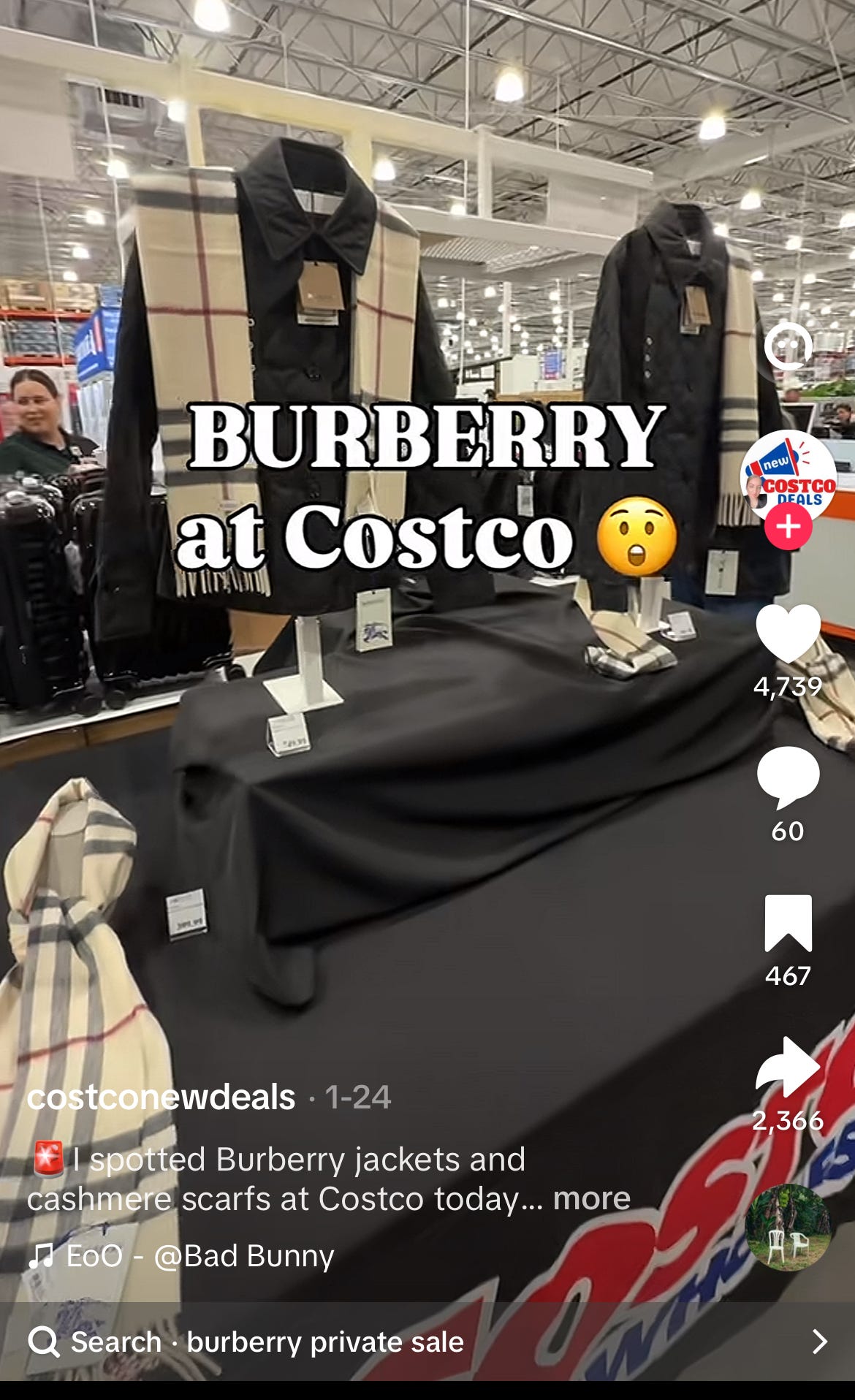
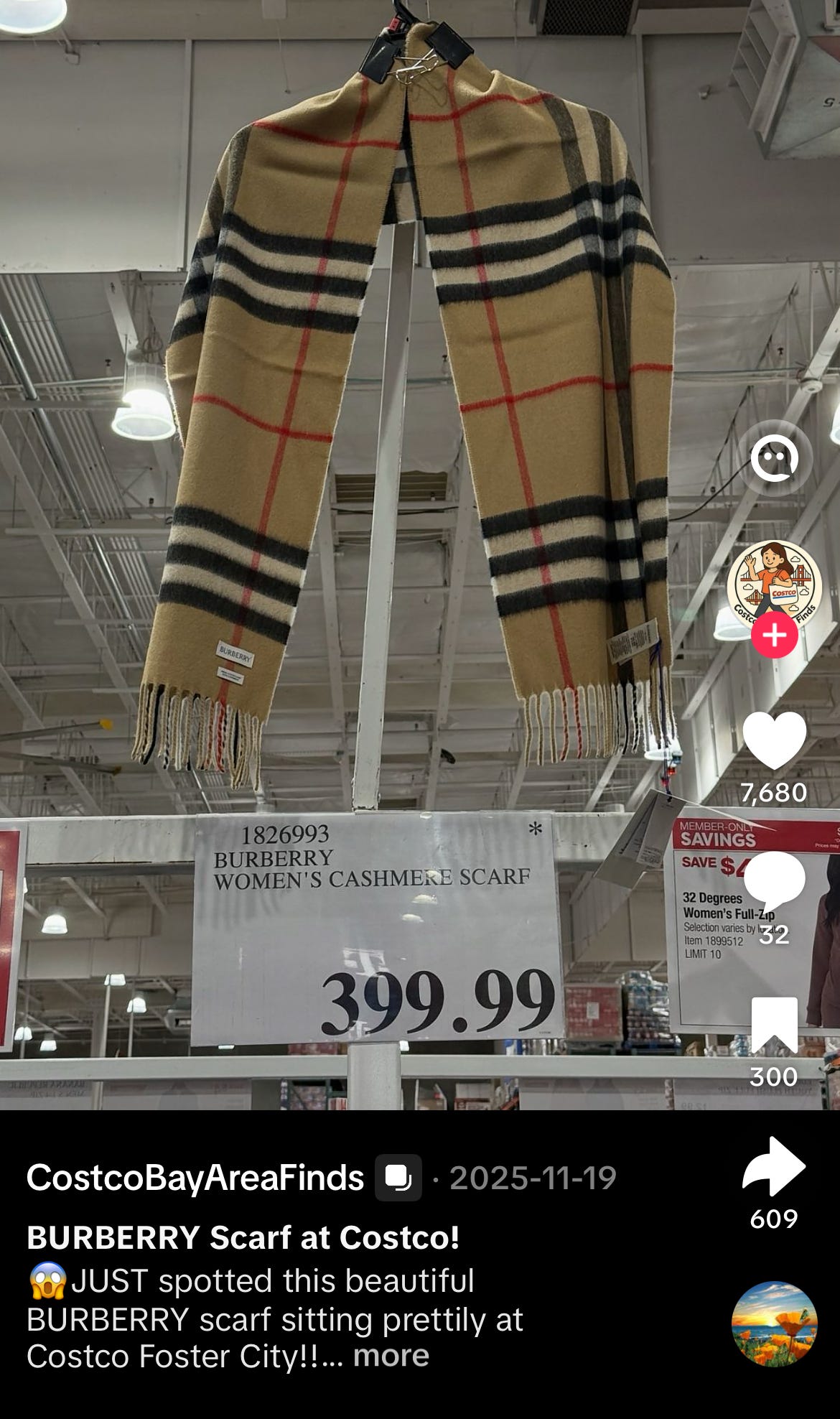
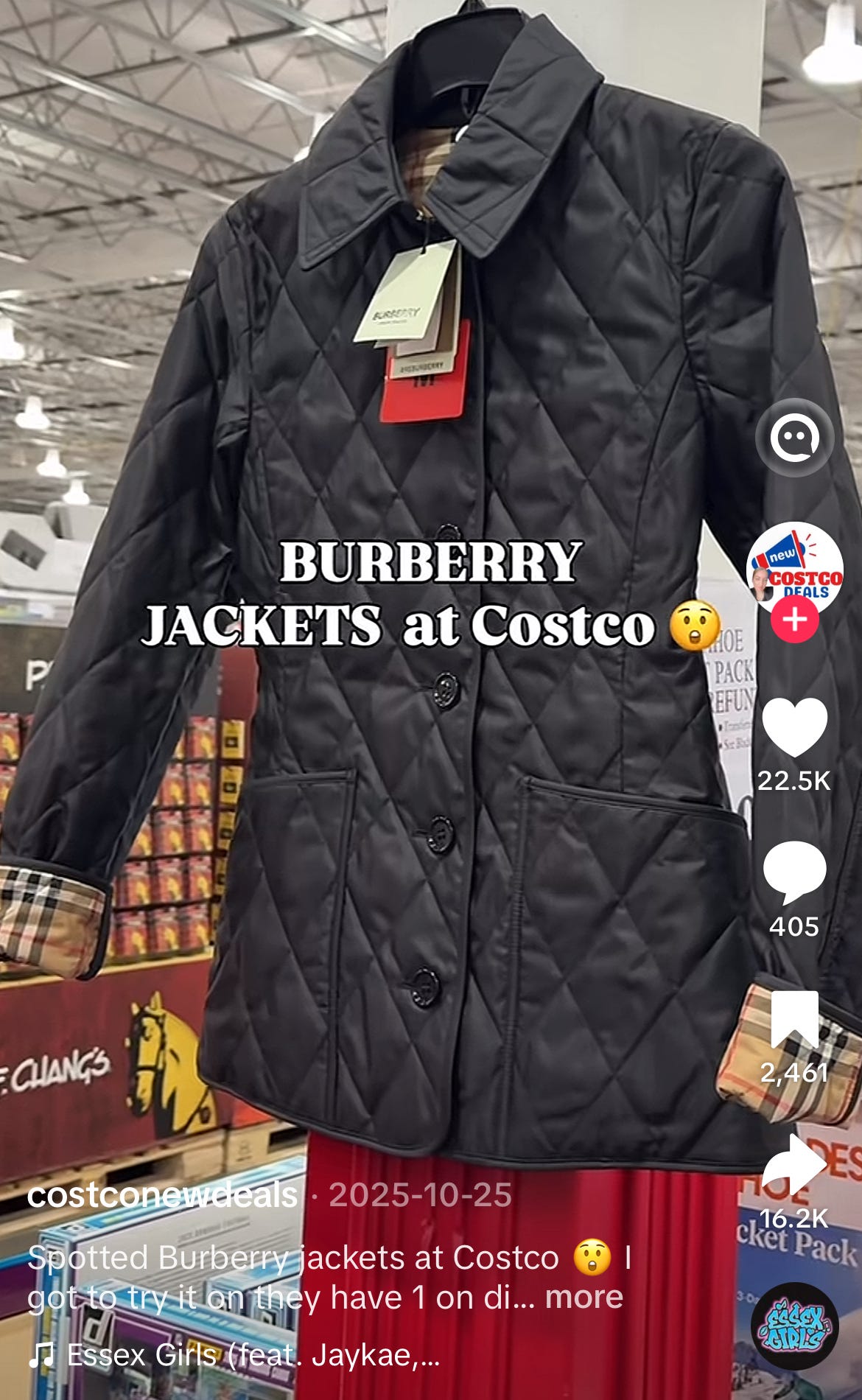
![TikTok screenshot from creator Costco Wonders dated January 28 and geo-tagged California, documenting a full Burberry merchandise activation at a US Costco Wholesale warehouse store. The image shows two mannequin-style display forms outfitted with Burberry black quilted outerwear and styled with the iconic Burberry check cashmere scarves in the signature camel, black, white, and red color palette, positioned on a black cloth-covered Costco merchandise table. Additional folded Burberry check scarves are arranged on both sides of the table, and individual price-sign cards are visible at the base of each display. The Costco Wholesale logo (red lettering with blue wave detailing and the "WHOLESALE" wordmark) is prominently displayed across the front of the table cloth, removing any ambiguity about the retail channel or whether this is an authorized or unauthorized distribution context. Behind the display, the warehouse's signature high-bay industrial racks stocked with palletized inventory, exposed steel-truss ceiling, and fluorescent overhead lighting are clearly visible. Bold white serif text overlay reads "BURBERRY AT COSTCO." The TikTok post caption reads "Costco just stocked a Burberry jacket and scarf set that feels like a [bonus/bargain]," and the video has 760 likes, 3 comments, 84 saves, and 323 shares, with a California location tag confirming US West Coast distribution. The styling of the jacket-and-scarf set as a coordinated outfit (rather than individual SKUs) suggests an intentional merchandising program rather than random parallel-import inventory, raising questions about whether Burberry has an active US wholesale agreement with Costco, whether this is liquidation through an authorized off-price channel partner, or whether this is gray-market parallel-import sourcing. Channel-check evidence material to Burberry $BRBY.L investors evaluating brand positioning discipline, distribution architecture, wholesale channel exposure, and the credibility of management's articulated heritage refocus narrative under CEO Joshua Schulman. The trench-and-scarf and quilted-jacket-and-scarf combinations being merchandised at Costco are precisely the hero category pairings the company cites as evidence of a successful return to heritage anchors.](https://substackcdn.com/image/fetch/$s_!Knjh!,f_auto,q_auto:good,fl_progressive:steep/https%3A%2F%2Fsubstack-post-media.s3.amazonaws.com%2Fpublic%2Fimages%2Fdf5d9985-04ab-480c-a6f8-fb6830b538a8_1170x1796.jpeg "TikTok screenshot from creator Costco Wonders dated January 28 and geo-tagged California, documenting a full Burberry merchandise activation at a US Costco Wholesale warehouse store. The image shows two mannequin-style display forms outfitted with Burberry black quilted outerwear and styled with the iconic Burberry check cashmere scarves in the signature camel, black, white, and red color palette, positioned on a black cloth-covered Costco merchandise table. Additional folded Burberry check scarves are arranged on both sides of the table, and individual price-sign cards are visible at the base of each display. The Costco Wholesale logo (red lettering with blue wave detailing and the \"WHOLESALE\" wordmark) is prominently displayed across the front of the table cloth, removing any ambiguity about the retail channel or whether this is an authorized or unauthorized distribution context. Behind the display, the warehouse's signature high-bay industrial racks stocked with palletized inventory, exposed steel-truss ceiling, and fluorescent overhead lighting are clearly visible. Bold white serif text overlay reads \"BURBERRY AT COSTCO.\" The TikTok post caption reads \"Costco just stocked a Burberry jacket and scarf set that feels like a [bonus/bargain],\" and the video has 760 likes, 3 comments, 84 saves, and 323 shares, with a California location tag confirming US West Coast distribution. The styling of the jacket-and-scarf set as a coordinated outfit (rather than individual SKUs) suggests an intentional merchandising program rather than random parallel-import inventory, raising questions about whether Burberry has an active US wholesale agreement with Costco, whether this is liquidation through an authorized off-price channel partner, or whether this is gray-market parallel-import sourcing. Channel-check evidence material to Burberry $BRBY.L investors evaluating brand positioning discipline, distribution architecture, wholesale channel exposure, and the credibility of management's articulated heritage refocus narrative under CEO Joshua Schulman. The trench-and-scarf and quilted-jacket-and-scarf combinations being merchandised at Costco are precisely the hero category pairings the company cites as evidence of a successful return to heritage anchors.")
7. Counterfeiting: Declined to Comment
Asked directly about counterfeiting of the check pattern and brand dilution risk, source said the topic was outside their remit. Worth noting given how central check exposure is to the current merchandising mix.
8. Management Tone: “Hands-On, Collaborative”
Standard corporate framing of the current leadership team: collaborative, hands-on, encouraging, improved atmosphere over the past year. No specifics offered. Source recently exited, so context for the rosy portrayal should be calibrated accordingly.
9. Marketing Pivot: Beach Clubs, Hotels, Tennis
Source (speaking personally, not from direct involvement) frames the partnership push (Antibes beach club, Ibiza hotel, tennis) as the playbook for reaching Gen Z and culturally-relevant audiences. Notes that brands leaning into “craftsmanship + cultural relevance” are the ones outperforming. This is the LVMH and Loro Piana playbook applied late. Whether Burberry has the brand equity to make these associations stick is the open question.
10. What Was Not Said
No discussion of wholesale rationalization, outlet exposure, regional EBIT margin trajectory, or inventory days on heritage SKUs vs. the lingering bag and shoe check inventory. Source self-described as strategy and business performance, but specifics on any of these were not volunteered and we did not press given the compliance posture.
Our View
This call did not change our positioning. If anything, it reinforced it. The most informative moments were not the rehearsed talking points on heritage refocus and category authority, which read like internal town-hall language. The interesting parts were the gaps:
A 2.5-year veteran of the Office of the CEO had never heard of the Costco distribution, which is observable to any consumer with a TikTok account.
Flagship cities as of the last 60 days do not match what one observes in store.
We continue to view the heritage-pivot narrative as the same playbook every troubled luxury house deploys at the bottom of a cycle. The interesting tells are channel execution, wholesale exposure, and how much of the recent print is genuine sell-through versus stock movement. None of which this call illuminated.
Useful, but as a confirmation of the consensus we are positioned against, not as new information. You can read the full transcript below.